


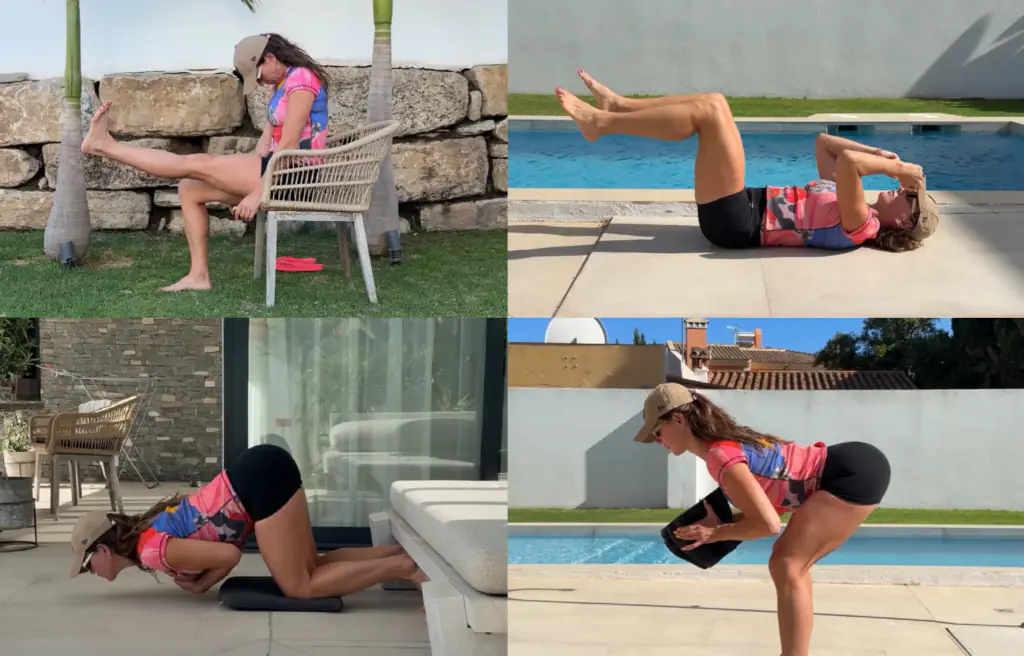
Most people blame their hamstrings when they can’t touch their toes. According to Vanja Moves, founder of Movesmethod, that assumption is often wrong. In a recent YouTube video, Vanja explained that chronic hamstring tightness is rarely caused by short hamstrings. Instead, she argues that the body is protecting something else in the movement chain, causing the nervous system to restrict range of motion.
“A tight hamstring is not a short hamstring,” Vanja says. “It is a protected hamstring.”
Rather than prescribing more stretching, Vanja outlines four common reasons hamstrings stay locked and provides a simple self-test for each one.
Cause #1: A Stuck Sciatic Nerve

The first potential culprit is the sciatic nerve.
Because the sciatic nerve runs through the posterior chain, irritation or restriction anywhere along its path can create sensations that are often mistaken for hamstring tightness.
To test this, Vanja recommends sitting tall in a chair, extending one leg, and comparing the sensation while moving the toes and changing the position of the neck.
“If the hamstring stretch suddenly increases dramatically, that is not your hamstring,” she says. “That is your sciatic nerve.”
Instead of stretching, Vanja recommends nerve flossing drills designed to improve nerve mobility and reduce protective tension.
Cause #2: An Anterior Pelvic Tilt
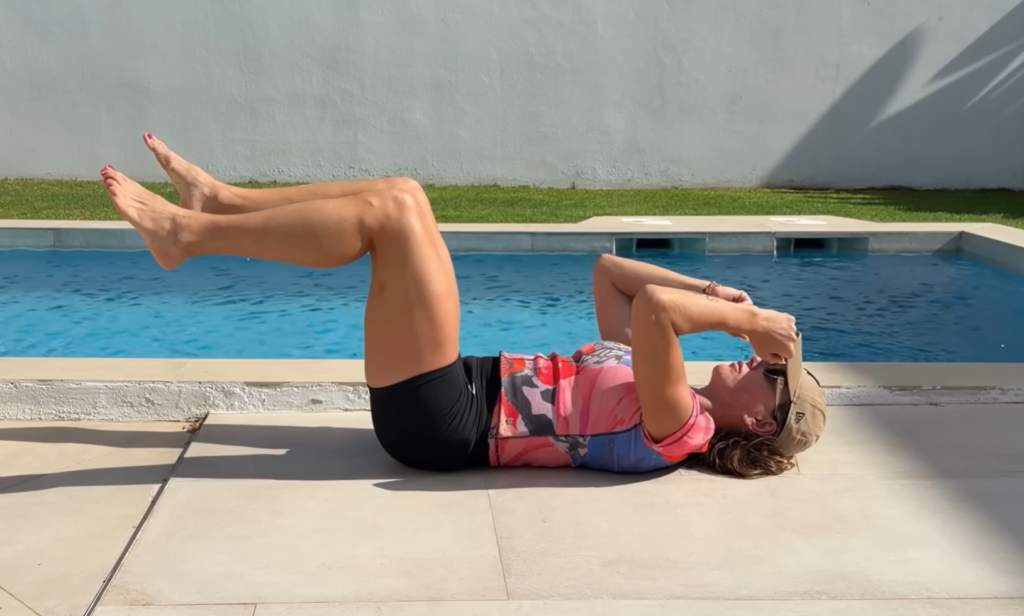
The second issue may be pelvic position.
Vanja explains that many people spend years sitting, resulting in an anterior pelvic tilt that places the hamstrings under constant tension before any stretching even begins.
“The hamstring is not short,” she says. “The pelvis has stolen the length from it.”
Her recommended assessment is a simple wall test. Stand with your heels several inches from a wall and attempt to flatten your lower back against it. Difficulty achieving this position may indicate excessive anterior pelvic tilt.
To correct it, Vanja recommends loaded posterior pelvic tilt exercises that help restore neutral alignment.
Cause #3: A Weak Posterior Chain

Vanja also challenges the idea that tight muscles always need more stretching.
In many cases, she argues, the nervous system tightens weak muscles as a protective strategy.
“A weak muscle feels tight,” Vanja says. “The brain tightens what it cannot trust.”
Her test involves lying face down, bending the knee to 90 degrees, and attempting to hold the position. If the hamstring cramps, weakness may be the underlying problem.
To build strength, she recommends eccentric-focused exercises such as Nordic curls.
Cause #4: Poor Hip Hinge Mechanics
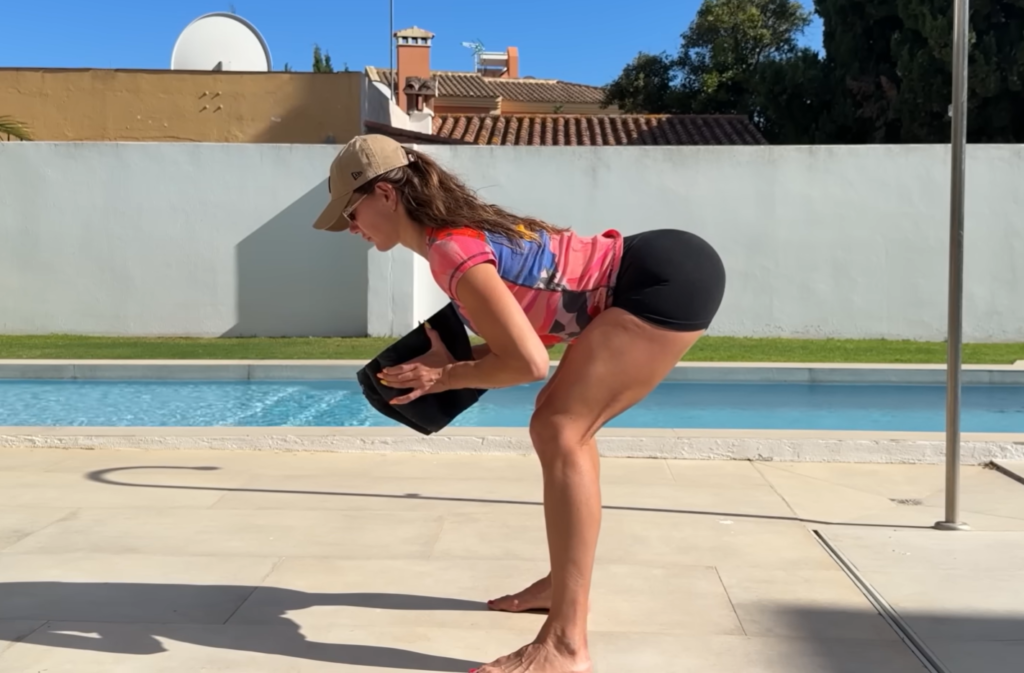
The final issue is a movement problem rather than a flexibility problem.
Many people believe they are stretching their hamstrings when bending forward, but Vanja argues they are often rounding through the lower back instead.
“The motion they are calling a hamstring stretch is happening in the spine,” she explains.
To assess this, she recommends using a stick placed along the spine while hinging forward. If the stick loses contact with the head, upper back, or tailbone, spinal flexion is occurring instead of a true hip hinge.
Loaded hinge variations with kettlebells or dumbbells can help retrain proper mechanics.
Address the Cause, Not the Symptom
Vanja shared the example of a long-distance runner who stretched his hamstrings daily for 15 years without meaningful improvement.
After identifying issues with nerve mobility, pelvic position, posterior-chain strength, and hip-hinge mechanics, the runner reportedly touched the floor within four weeks without performing any traditional hamstring stretches.
“You cannot stretch what is being held for a reason,” Vanja says. “Address the reason, the body releases.”
Her message is simple: if your hamstrings always feel tight, the muscle itself may not be the problem at all.
About the Author
Jeremiah Oliva

Jeremiah Oliva is a writer passionate about fitness, sports, and active living. He has experience in songwriting and managing content and social media for online radio and magazine platforms.
He covers HYROX, CrossFit®, and competitive fitness, with a focus on performance, mindset, and athlete development.
Outside of writing, Jeremiah trains in boxing, cycles, explores the outdoors with his kids, and plays the guitar.
