


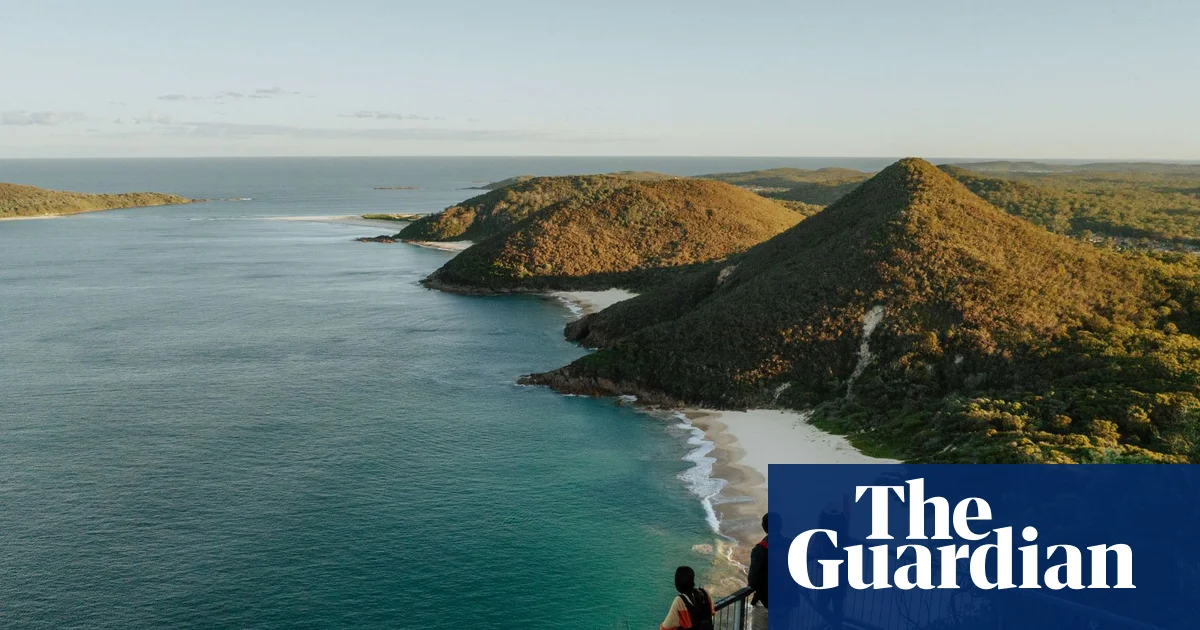
The waves are tracking higher than the average Australian house when the opportunity arises to bare all. We’ve arrived on foot at Samurai beach, a remote nudist spot midway along the 27km Tomaree coastal walk on the New South Wales mid-north coast in the Port Stephens area. The one-in-50-year swell battering the state’s shoreline has clearly scared off the usual cohort of weekend naturists who come to this vast stretch of sand for its south-facing surf, salt-sprayed seclusion and pristine sand dunes.
Clothing removal is optional here, but my bushwalking buddy and I agree it would be rude not to experience the beach as it was intended. The only witnesses to our gleeful antics are a handful of nonchalant magpies foraging on the sand between bits of microplastic, and a Gould’s petrel (the endangered seabird that nests on the nearby islands off Port Stephens) hovering high above the breakers like a grey and white drone with a 75cm wingspan.
We’re on day two of the self-guided coastal walk, which opened to the public in spring 2023 and is one of NSW’s official Great Walks. The well-marked trail traverses the beaches, dunes, bays, headlands, rock platforms, canyons, wetlands, coastal heath, angophora forests and historic Indigenous and second world war sites that lie within Tomaree national park, linking the holiday village of Shoal Bay in the north with the quieter Anna Bay in the south. It’s designed to be walked in two days, and there are eateries and places to stay en route in Fingal Bay and One Mile. The Port Stephens Koala Sanctuary – located behind the dunes of Samurai beach – is a popular “base camp” for many hikers, offering glamping tents and other accommodation inside the eight-hectare sanctuary that also houses a koala hospital, rehabilitation centre and treetop walking platforms.
We meet fellow bushwalkers with less time and more energy than us doing the entire track in one day – seeing the sun rise from the 161m-high Tomaree Head in the north with its panoramic views over Port Stephens, and the sun set at Birubi Point Aboriginal Place in the south, a site of cultural significance to the traditional custodians, the Worimi people. Birubi Point sits adjacent to the Worimi Conservation Lands, where camel rides, sand boarding and quad bike tours are offered on the southern hemisphere’s longest mobile coastal sand dunes.
We’ve opted to do the walk over a leisurely three days, basing ourselves at a holiday rental in Shoal Bay, and using local buses and taxis to travel between towns on the trail. This allows for morning sleep-ins, unrushed coffees and homemade pies at local cafes, long picnic lunches while we drape like mermaids over beachside rocks, afternoon dips in the sheltered waters of Port Stephens, and sunset cocktails overlooking whichever body of water we’ve walked to that day. And, it goes without saying, lots of stops to ogle and photograph the magnificent scenery.
Tomaree means “place of the rainbow” in the Gathang language of the Worimi people. Sure enough, we’re treated to gentle rain and blazing sunshine during our three-day walk, though thankfully not the slithering ground dwellers that such changes in weather attract – leeches in the wet followed by basking snakes on vitamin D binges. More than once we pass cheerful locals who remark on the glorious weather, only to add: “But the brown snakes love it too – be sure to keep your eyes glued to the ground.”
Spend too long looking down, however, and you’ll miss what lives above – koalas, white-bellied sea eagles and sooty oystercatchers, as well as the park’s star flora: striking red gymea lilies that tower above the weatherworn banksias. Out on the ocean, which is almost always visible from the track, you might glimpse bottlenose dolphins or a fur seal.
However, the walk really comes into its own between May and November, when the annual humpback highway is in motion. The elevated headlands and viewing platforms of Tomaree national park make it one of the best places in NSW to witness whales migrating up and down the rugged coastline.
By our third and final day of the walk, the monster swell has subsided, the surf lifesavers are back in business, and our biggest decision is which of the track’s 10 stunning beaches we should go to for our end-of-walk swim.
We decide on One Mile, a patrolled beach, and arrive to find a group of children having their first surfing lesson, paddling out through the slow-breaking waves. The day’s sweat and dirt dissolve as we duck and dive between the flags. No nipples are freed today, but with just sand, sea and sky as far as the eye can see, nothing could feel more liberating.
Accommodation
The clothing-optional Samurai beach campground, located in the dunes behind the beach, has no amenities and is the only national park-run campsite on the track ($6 booking fee, for up to seven nights). The coastal villages of Shoal Bay, Fingal Bay, One Mile and Anna Bay have shops, eateries and places to stay, including beachfront holiday parks with accommodation that ranges from camping sites to self-contained cabins. The Port Stephens Koala Sanctuary in One Mile offers glamping tents (from $250 per night for two) and suites ($259 a night) that sleep up to four people.
Getting there and around
Shoal Bay in Port Stephens is 220km or up to three hours north of the Sydney CBD, and one hour north of Newcastle. Port Stephens Coaches runs a daily express bus from Sydney (from three hours one way, $65 adult return). The route 130 bus links towns on the Tomaree coastal walk, and Diggers taxis (02 4032 7999) have a fleet of drivers in the area. Shoal Bay and Anna Bay are the official gateways to the Tomaree coastal walk, but parking is available at Fingal Bay, One Mile beach, Boat Harbour, Fishermans Bay and Birubi Point, allowing hikers to join the track wherever convenient.
More information
Entry to Tomaree national park is free. Public toilets, picnic tables, information boards and water refill points are dotted along the route (see this map of the Tomaree coastal walk). The walk is classed as “moderately challenging”, and rain can make the rock platforms slippery. For updates on track closures and public safety, see the NSW National Parks and Wildlife Service website.
