


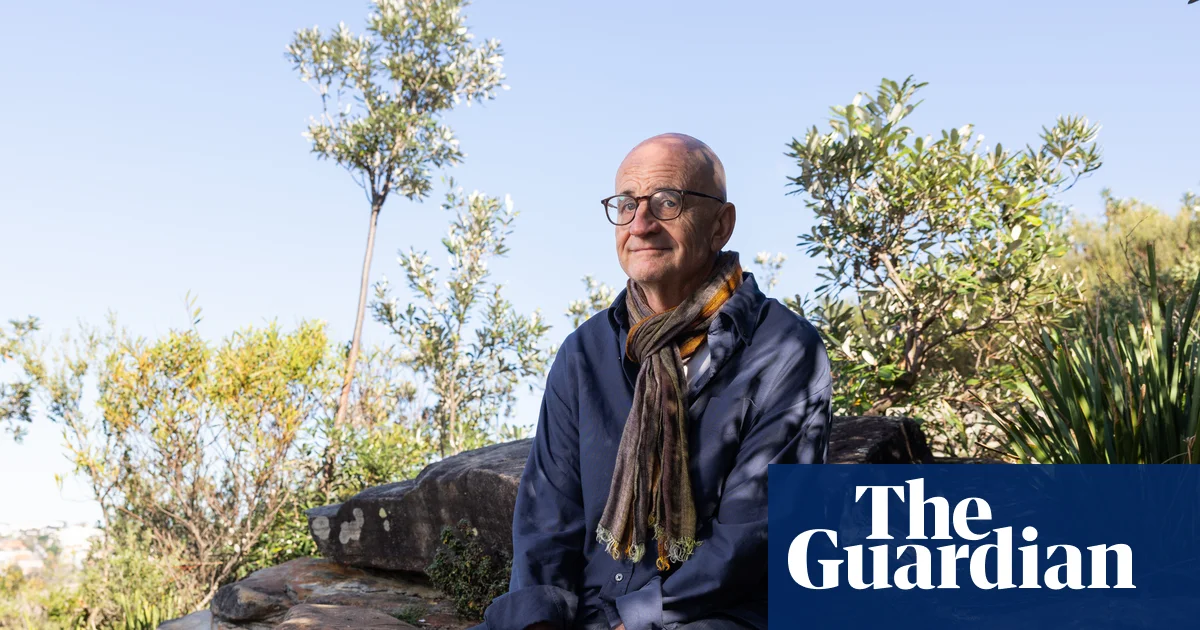
Strolling along the clifftop path that winds down to Coogee beach, James O’Loghlin and I pass a steady stream of small, ordinary pleasures. A well-fed beagle is lifted from a car for a walk; a woman in pink tights stretches on a yoga mat in the midday sun; an older couple share hot chips on the grass.
“There’s a guy skipping, that’s nice,” O’Loghlin says, pointing at an athletic-looking young man with a rope.
O’Loghlin, a comedian, writer and broadcaster, is an upbeat walking companion; quick to laugh, relentlessly curious and “always looking for stories”.
The former lawyer has had a long career at the ABC and now hosts the New South Wales ABC radio afternoon program. He has also published several crime novels. “I love the puzzle of them,” he says.
Today, though, he is sharing a more personal story, one that grew out of friendship, illness and two years of lobbying governments.
O’Loghlin’s new book, The Missing Piece, charts his friendship with and the tragic loss of James Wallner, a university mate known as “Jum”, whose smile was “so big it could swallow the world”.
The pair met in the mid-80s at the University of Sydney while living on campus at Wesley College. They were best friends. “Jum was the easiest person to hang out with,” he says. “Funny, smart, very interested in people, really good-hearted, you know?”
After university, careers, children and distance accumulated. O’Loghlin says he let “cobwebs grow over” their friendship. “We both thought there would be plenty of time to see each other when our lives were less busy,” he says. “And suddenly there wasn’t.”
As we continue walking downhill, looking out over the ocean, O’Loghlin recalls learning that Jum had been diagnosed with mesothelioma – a rare, aggressive cancer almost always linked to asbestos exposure. Jum was 54, young for a diagnosis like that.
O’Loghlin drove from Sydney to Canberra, where Jum had grown up in a Mr Fluffy house insulated with loose-fill asbestos, the friable insulation installed in more than 1,000 Canberra homes in the 1960s and 70s.
When he arrived, Jum opened the door and extended his arms.
“I had never hugged a male friend before,” O’Loghlin recalls. He says it matter-of-factly, as though only now realising how unusual that might sound. “That was the first hug, and it was nice.”
The hugs kept coming. After Jum’s death, they felt natural at his funeral and among grieving friends. These days, O’Loghlin is a regular hugger.
“I don’t hug my tennis buddies every Tuesday here in Coogee,” he says laughing, as we circle around the famous rainbow steps at Coogee Beach. “But with friends I haven’t seen for a while, it’s nice. Women do it far more naturally and frequently, don’t they? Us men should get into it a bit.”
The first friendship test came early. “Whenever someone has a dying friend, you need to decide if you lean in or lean out,” he says. “With family we don’t often get a choice – you lean in because you have to. But with friends, we do have a choice.”
He admits he leaned out when someone close to him got sick over two decades ago. “I still regret that,” he says. “Leaning in is harder, and there’s a cost to it, but it can also be very, very rewarding and rich. It can take a relationship with someone to a deeper level.”
O’Loghlin’s book is full of gallows humour, self-doubt and second-guessing as he simultaneously unpacks his awkward feelings around caring for a dying friend – do I text? Do I visit or give them space? How do I act if I visit? – and being catapulted into accidental activism.
As he learned more about mesothelioma, he discovered a cruel anomaly. People exposed to asbestos at work were eligible for compensation, but those exposed at home were not. Together with two friends, he launched a campaign to change the rules before time ran out for Jum.
“I was a total novice, I wasn’t an activist at all,” O’Loghlin says emphatically. “I barely even read the news. I was tested in so many ways.”
O’Loghlin pondered what he could even do in a campaign and realised he was “crap at baking” so it wouldn’t be baking cookies. Instead, as a writer, he offered to draft letters to the government – federal and ACT. But how to get a letter out of the pile of other requests to get it really noticed? He tried relentless follow-up emails, phone messages and recruiting the help of every possible friend and contact they knew in Canberra, including trade unions, health organisations and the media.
“I’d lie awake at night thinking: “Is there one thing, one thing I can do that will make a difference to my dying friend? How am I going to do it? What more can I do? Who can I talk to? How can I prod them more?” That was a real test,” O’Loghlin says. “I didn’t want to be left with that ‘What if I’d tried harder?’ feeling. I wanted to know I’d done everything I could.”
We stop walking to get out of the wind and sit down on a park bench. The ocean in front of us is glittering. Here, O’Loghlin drops his voice.
“When Jum got sick, we’d both been a bit cavalier with time,” he says. “We thought it was abundant. Seeing him go downhill was hard. Mesothelioma is a brutal disease. Every time I visited, he was in a worse state, on more painkillers, finding it harder to move around, in more pain. Breathing issues, the oxygen tank, wheeling that around with him.”
He recalls asking Jum how he was feeling one day during his treatments. “He said ‘seven out of 10’, even after the chemo and all the painkillers, and he knew he was never going to get better. But he also said he would have said seven a year ago, before he got diagnosed, because it would have been something going wrong at work, or a sore knee, or something.”
Jum said: “Funny thing is, once you don’t have your health, you realise that your life was a 10 out of 10 before.”
“That really stayed with me,” O’Loghlin says. “Death is coming for us all. Now I have a determination to seek out the things that make me happy and if I’m not happy about something, I’ve learned to soften my brain and let things float away.”
“How are you today?” I ask.
“A solid three,” he jokes and lets out a belly laugh. “No, I’m a nine. Someone is asking me interesting questions about a story I’ve written, we’re sitting in the sun, and your photographer bought me an apple juice and wouldn’t let me pay, that’s nice. Maybe I’m a nine and a half!”
We walk back along the beach towards north Coogee, up the clifftop and into the park where the kangaroo paws are blooming red and yellow.
We talk about death and his chapter detailing very practical tips for how to deal with a dying friend. “When a friend is dying you want to make sure you talk about what they want to talk about. It’s not about you, and they shouldn’t have to become your grief counsellor – go out and have a cry in the car,” he suggests.
“It’s hard to bring up death,” O’Loghlin says – but sometimes the dying person might offer a clue that they want to talk about it. “One day Jum said, ‘I probably won’t see the flowers bloom.’ That’s a hint, isn’t it? There’s an opportunity to say, ‘Well, I hope you do,’ or ‘That’s a bummer.’ Give them space to say something else if they want to.”
In the end, the campaign succeeded. The health minister at the time, Greg Hunt, confirmed a fund after 11 weeks and two days of lobbying. “Full credit to the government,” O’Loghlin says with a nod.
Jum died two days later.
The campaign’s success brought some comfort, but O’Loghlin rejects the idea that tragedy is somehow balanced by a later reward. “Karma can go fuck itself.” He laughs.
As we head back to the start of our walk, we notice a single lorikeet enjoying the nectar of a grevillea flower.
“Time is something you never get back,” he says quietly. “We are all going to have to decide whether to lean in or lean out. Every single one of us is going to have a dying friend, unless we are one.” He says this with a shrug.
“I would really strongly recommend getting over the awkwardness. Sometimes words will come out wrong. It’ll be clunky. But it’s much better than after they’re dead, thinking, ‘I wish I’d said that.’
“So, get into it.”
