


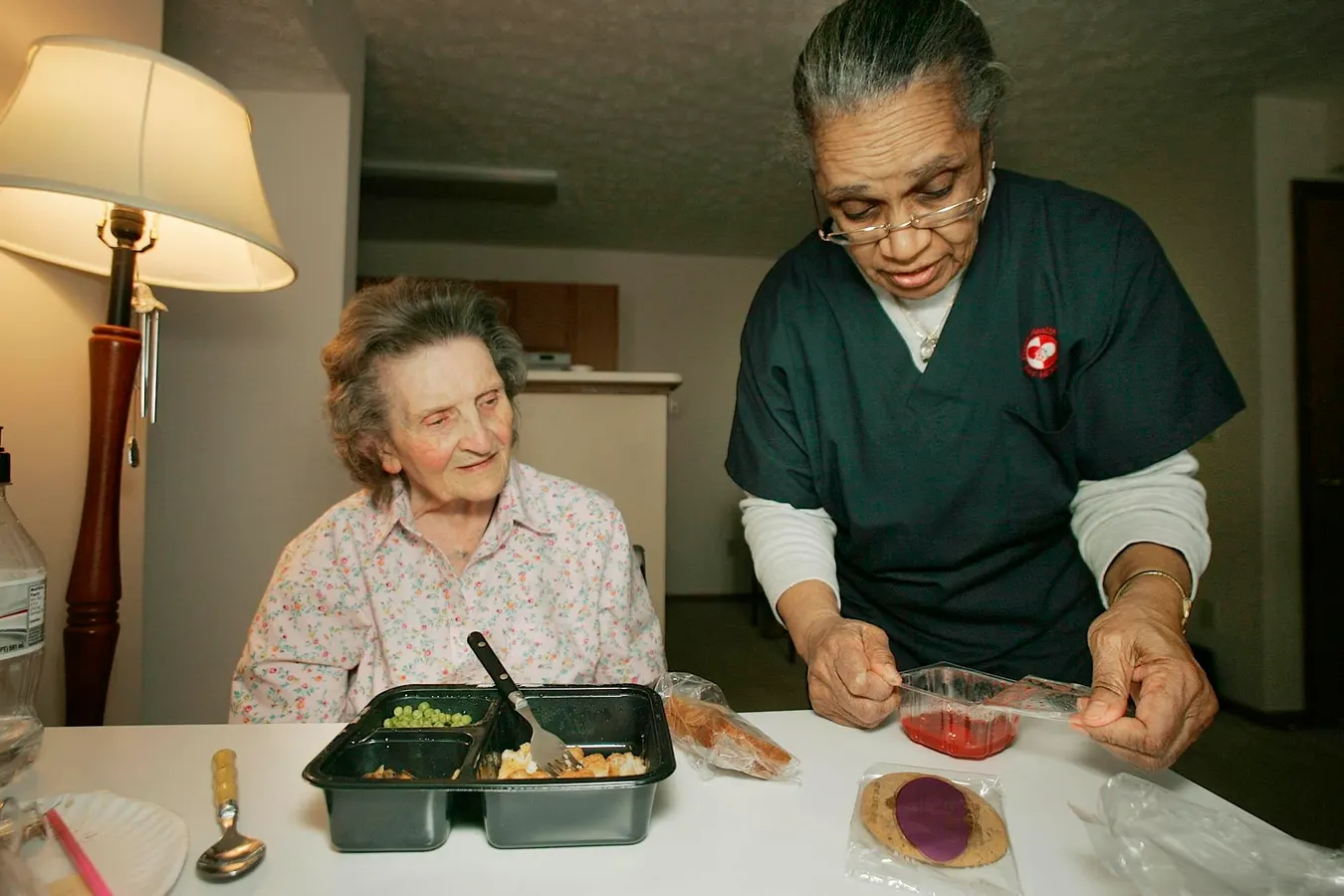
Alice Terrell, left, and her caregiver Frances McDaniel at lunch at Terrell’s home in Columbus, Ohio, January 31, 2005. (Photo by Neal C. Lauron/MCT/Tribune News Service via Getty Images)
Tribune News Service via Getty Images
The Department of Justice’s decision to stop protecting the right of people with disabilities to remain in their homes will make it easier for states to slash home care benefits in response to deep federally-mandated cuts in Medicaid funding. The decision, effectively a federal get-out-of-jail-free card for states, will harm many vulnerable people, including older adults.
The DOJ said it will no longer enforce a nearly 30-year-old Supreme Court decision in a case called Olmstead v. L.C. ex rel. Zimring. The Olmstead ruling requires states to provide care for Medicaid recipients in the most integrated, least restrictive setting possible. Since Olmstead, that has been broadly interpreted to mean care in someone’s own home or community rather than in a nursing home or public institution.
But, in a June memo, the Justice Department took a far narrower interpretation of Olmstead and said it would no longer enforce an integrated care requirement. While individuals and their families may still sue states, the federal government won’t. Nor will it support private lawsuits, as it has frequently in the past.
DOJ’s Important Role
Until now, DOJ has played two important, related roles in enforcing Olmstead. Sometimes, it directly sued states for violating the law by failing to provide quality home-based alternatives to institutional care. In other cases, it intervened in private lawsuits brought by older adults or people with disabilities or their families (see here and here).
In recent years, the federal government has sued states or joined private lawsuits more than 50 times over Olmstead violations. Nearly all cases were settled, usually resulting in some expansion of home- and community-based care.
Advocates were outraged at the timing of the DOJ announcement because it came on the anniversary of the Olmstead decision, most likely not a coincidence. But the timing was more than symbolic. It has far more important, practical consequences when paired with the Trump Administration’s aggressive efforts to slash Medicaid benefits for older adults and younger people with disabilities.
A Multi-Front Attack
Over the past year, the Administration has pursued a multi-front attack on Medicaid, much seemingly aimed, directly and indirectly, at home and community-based care.
Last summer’s big budget bill, HR 1, cut Medicaid funding by nearly $1 trillion over the next decade. While it did not explicitly cut funding for home-based care, that will be the law’s effect in many states.
That’s because states are required to provide long-term care in nursing homes but not in people’s homes or communities. States may choose to provide home- and community-based care (and all do) but they are not obligated to provide that care.
When faced with the funding cuts HR 1 will require, states are very likely to target optional benefits, often called waiver programs. Indeed, several already have done so, even though home-based care generally is less costly than the nursing home alternative.
For example, Idaho has cut payments to home care providers, Colorado is making Medicaid enrollment more difficult, and Iowa is cutting payments to caregivers of people living at home.
While HR 1’s impact on HCBS was indirect, the Administration has more recently directly targeted home-based care.
First, it declared a war on what it alleged is widespread fraud in Medicaid, especially in what are called consumer-directed programs, where family members may be paid directly for caring for relatives.
In most cases, the alleged fraud was committed by contractors hired to administer the programs, not by families themselves. However, because the allegations often are accompanied by major suspensions of federal Medicaid payments, the result is frail older adults, people with disabilities, and their families are losing benefits.
On top of these Medicaid changes, the Administration’s crackdown on immigrants, including those living and working legally in the US, has worsened a serious shortage of direct care workers. That has increased costs for Medicaid as well as for families paying out of their own pockets for care.
The Impact
What can be done about DOJ’s reinterpretation of Olmstead? Not much, probably. The Justice Department has broad discretion in the cases it brings or joins. And it will be a challenge for advocates to convince a court to force DOJ to bring lawsuits.
The result, then, will be that states now have a much freer hand in how they respond to federal Medicaid cuts. Without DOJ looking over their shoulders, they’ll be able to slash HCBS funding much more easily. Individuals and their families still will be able to sue, and many likely will. But they’ll have a much higher hill to climb faced with the opposition of the federal government.
