



Building a bigger and stronger chest is one of the most common fitness goals for beginners. A well developed chest improves upper body strength, enhances posture, supports athletic performance, and creates a balanced physique. The good news is that you do not need complicated training methods or dozens of different exercises to make impressive progress.
Research consistently shows that beginners respond extremely well to basic compound movements combined with consistent progressive overload. Learning proper technique, training with good effort, and allowing enough recovery are far more important than constantly changing exercises.
The pectoralis major is the largest chest muscle and is responsible for horizontal adduction, shoulder flexion, and internal rotation. Beneath it lies the pectoralis minor, which helps stabilize the shoulder blade. Effective chest training also recruits the anterior deltoids and triceps, making many pressing exercises excellent choices for building overall upper body strength. These five exercises provide everything a beginner needs to develop a stronger and more muscular chest.
What Makes a Great Beginner Chest Exercise?
Not every chest exercise deserves a place in a beginner program. The best movements share several important qualities.
- They allow safe and progressive overload over months and years.
- They train multiple muscle groups at once, helping beginners build strength efficiently.
- They reinforce proper movement patterns that carry over to more advanced lifts.
- They can be adapted to different strength levels.
Scientific evidence also suggests that performing exercises through a full range of motion generally leads to greater muscle growth than partial repetitions. A controlled eccentric phase, combined with challenging but manageable loads, maximizes muscular adaptations while reducing injury risk.
1. Barbell Bench Press
The barbell bench press remains the king of chest exercises for good reason. It allows beginners to lift relatively heavy loads while training the chest, shoulders, and triceps simultaneously.
Why It Works
The bench press produces high levels of activation in the pectoralis major while allowing gradual increases in weight over time. This makes it one of the most effective exercises for developing both strength and muscle mass.
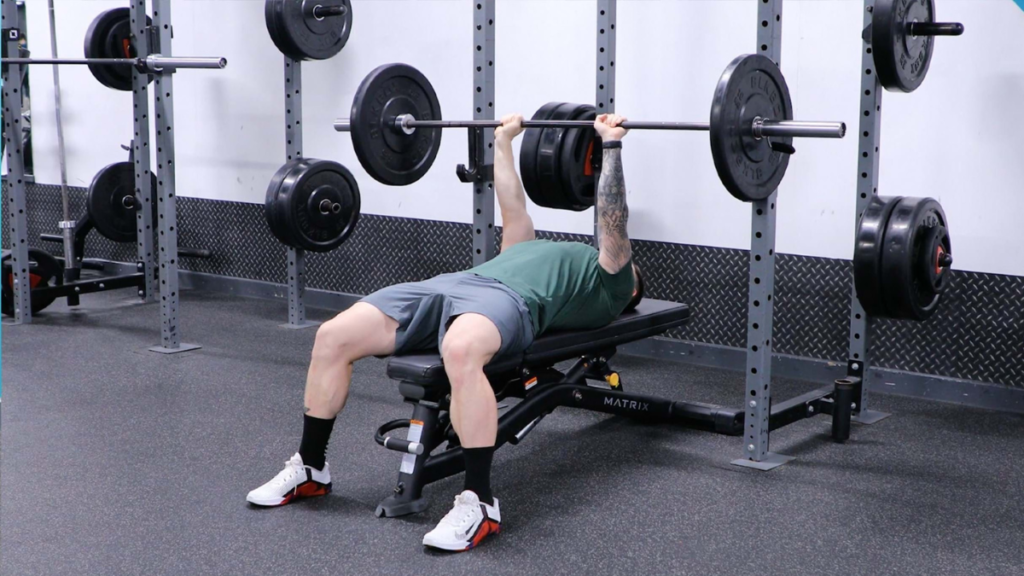
Numerous studies comparing resistance exercises consistently place the bench press among the best choices for overall chest development because of its ability to create substantial mechanical tension.
For beginners, mastering the bench press also builds coordination, stability, and confidence with free weights.
How to Perform It
- Lie flat on the bench with your eyes directly beneath the bar.
- Plant both feet firmly on the floor.
- Grip the bar slightly wider than shoulder width.
- Retract your shoulder blades and keep your chest lifted.
- Lower the bar under control until it lightly touches the middle of your chest.
- Press the bar upward until your elbows are nearly locked.
- Repeat without bouncing the bar.
Common Mistakes
Many beginners flare their elbows excessively, which places unnecessary stress on the shoulders. Others bounce the bar off the chest or lift their hips from the bench to complete difficult repetitions.
Instead, maintain control throughout every repetition and focus on smooth movement.
Beginner Recommendation
Complete three to four sets of six to ten repetitions while leaving one or two repetitions in reserve before muscular failure.
2. Push Up
Few exercises are as accessible or as effective as the push up. Although many people view it as a simple bodyweight movement, research shows that properly performed push ups can stimulate chest muscles almost as effectively as traditional bench pressing when the relative effort is similar.

Why It Works
Push ups train the chest, shoulders, triceps, and core simultaneously. They also improve shoulder stability because the shoulder blades move naturally throughout each repetition.
Unlike machines, push ups encourage better movement quality and body control. As strength improves, beginners can increase difficulty by elevating the feet, wearing a weighted vest, or using resistance bands.
How to Perform It
- Place your hands slightly wider than shoulder width.
- Keep your body in a straight line from your head to your heels.
- Brace your core and squeeze your glutes.
- Lower your chest until it nearly touches the floor.
- Press yourself back up without allowing your hips to sag.
Common Mistakes
The most common errors include letting the hips drop, shortening the range of motion, and flaring the elbows excessively. Each repetition should remain controlled from start to finish.
Beginner Recommendation
Perform three sets of as many quality repetitions as possible while stopping before technique breaks down. If standard push ups are too difficult, begin with incline push ups using a bench or sturdy box.
3. Incline Dumbbell Press
The incline dumbbell press emphasizes the upper portion of the chest while improving shoulder stability and correcting side to side strength differences.
Many beginners develop stronger dominant sides during barbell training. Dumbbells force each arm to work independently, helping eliminate these imbalances.
Why It Works
Using dumbbells allows greater freedom of movement than a fixed barbell. Many lifters find this more comfortable on the shoulders.
Research examining muscle activation has shown that moderate incline angles effectively recruit the clavicular portion of the pectoralis major while still heavily involving the rest of the chest. The increased range of motion available with dumbbells may also enhance muscle growth by placing the chest under tension through a larger movement.
How to Perform It
- Adjust the bench to approximately thirty degrees.
- Hold one dumbbell in each hand.
- Press the weights above your shoulders.
- Lower both dumbbells until your elbows reach approximately ninety degrees or slightly below.
- Press back upward while maintaining control.
- Bring the dumbbells together above your chest without smashing them together.
Common Mistakes
Avoid setting the bench too steeply because higher angles shift more work toward the shoulders. Do not allow the weights to bounce at the bottom or drift too far behind your body.
Beginner Recommendation
Complete three sets of eight to twelve repetitions using a weight that allows perfect technique.
4. Chest Dip
Chest dips are often viewed as an advanced exercise, but assisted dip machines or resistance bands make them accessible for many beginners.
When performed with a slight forward lean, dips become an outstanding exercise for developing the lower chest while also strengthening the shoulders and triceps.

Why It Works
Chest dips create substantial tension across the pectoralis major through a deep stretch.
Research suggests that training muscles under tension at longer muscle lengths may contribute to greater hypertrophy. Dips naturally expose the chest to this type of loading when performed correctly.
As strength improves, additional weight can easily be added.
How to Perform It
- Grip the dip handles securely.
- Lean your torso slightly forward.
- Cross your ankles if comfortable.
- Lower yourself under control until your upper arms are roughly parallel to the floor.
- Press upward until your elbows are nearly straight.
Common Mistakes
Remaining perfectly upright shifts more emphasis toward the triceps. Dropping too deeply before developing adequate mobility may irritate the shoulders. Use only the range of motion that feels comfortable and pain free.
Beginner Recommendation
Perform two to three sets of six to ten repetitions using assistance if necessary.
5. Cable Chest Fly
Compound exercises build most of your strength and muscle, but isolation work provides additional training volume while placing continuous tension directly on the chest.
Cable flyes are particularly beginner friendly because the resistance remains consistent throughout the movement.
Why It Works
Unlike free weights, cables maintain tension during nearly the entire repetition. This constant resistance allows beginners to focus on feeling the chest muscles contract without balancing heavy weights. Cable flyes also allow training through a large range of motion while using relatively light loads, reducing stress on the joints.
How to Perform It
- Stand between two cable pulleys.
- Grip both handles with a slight bend in your elbows.
- Step forward into a stable position.
- Bring your hands together in front of your chest in a wide hugging motion.
- Slowly return to the starting position while maintaining control.
Common Mistakes
Avoid turning the exercise into a press by excessively bending the elbows. Do not allow momentum to control the movement. Focus on squeezing the chest throughout every repetition.
Beginner Recommendation
Perform three sets of ten to fifteen controlled repetitions.
How Often Should Beginners Train Their Chest?
Most beginners achieve excellent results by training the chest two times per week. Research comparing different training frequencies suggests that training each muscle group at least twice weekly often produces greater muscle growth than performing all weekly volume in a single workout.
For example, one workout might emphasize heavier pressing movements while the second session uses slightly higher repetitions and more isolation work. Consistency matters far more than chasing the perfect split.
Progression Is the Secret to Long Term Results
Many beginners make rapid gains during their first year of lifting, but only if they continue challenging their muscles. Progressive overload simply means gradually increasing the demands placed on the body.
This can involve adding weight, performing additional repetitions, increasing total training volume, improving exercise technique, or controlling each repetition more effectively. Keeping a training log makes progression much easier. Even adding one extra repetition every week eventually leads to dramatic improvements over months of consistent training.
Final Thoughts
A stronger and more muscular chest does not require endless exercise variation or complicated workout plans.
The barbell bench press develops maximal pressing strength and overall chest size. Push ups build functional strength using only body weight. Incline dumbbell presses target the upper chest while improving muscular balance. Chest dips strengthen the lower chest through a large range of motion. Cable flyes provide focused isolation work that complements heavy pressing exercises.
Together, these five exercises cover every major movement pattern needed for chest development.
Train consistently, eat enough high quality protein, prioritize good technique, and gradually increase the challenge over time. Beginners who follow these principles will build impressive strength and muscle while creating a solid foundation for years of successful training.
Key Takeaways
| Topic | Key Point |
|---|---|
| Best overall exercise | The barbell bench press remains the most effective compound lift for building chest strength and muscle. |
| Best bodyweight exercise | Push ups effectively build the chest, shoulders, triceps, and core while requiring no equipment. |
| Upper chest development | Incline dumbbell presses emphasize the upper chest and improve side to side muscular balance. |
| Lower chest development | Chest dips effectively target the lower chest while strengthening the triceps and shoulders. |
| Isolation exercise | Cable chest flyes provide continuous tension and complement heavy pressing exercises. |
| Weekly frequency | Train the chest two times per week for optimal beginner progress. |
| Weekly volume | Aim for approximately ten to twenty challenging sets per week, starting near the lower end. |
| Nutrition | Consume 1.4 to 2.2 grams of protein per kilogram of body weight daily to support muscle growth. |
| Long term progress | Apply progressive overload by gradually increasing weight, repetitions, or training volume over time. |
References
- American College of Sports Medicine. (2021). ACSM’s Guidelines for Exercise Testing and Prescription. 11th ed. Philadelphia: Wolters Kluwer.
- Grgic, J., Schoenfeld, B.J., Orazem, J. and Sabol, F. (2022). Effects of resistance training performed to repetition failure or non failure on muscular strength and hypertrophy. Journal of Sport and Health Science, 11(2), pp.202 to 211.
- Krzysztofik, M., Wilk, M., Wojdała, G. and Gołaś, A. (2019). Maximizing muscle hypertrophy. A systematic review of advanced resistance training techniques and methods. International Journal of Environmental Research and Public Health, 16(24), 4897.
- Lasevicius, T., Schoenfeld, B.J., Silva Batista, M., Barros de Salles, B.F., Aihara, A.Y., Brendon, H., Longo, A.R. and Teixeira, E.L. (2019). Muscle failure promotes greater muscle hypertrophy in low load but not in high load resistance training. Journal of Strength and Conditioning Research, 36(2), pp.346 to 351.
- Schoenfeld, B.J. (2010). The mechanisms of muscle hypertrophy and their application to resistance training. Journal of Strength and Conditioning Research, 24(10), pp.2857 to 2872.
- Schoenfeld, B.J., Ogborn, D. and Krieger, J.W. (2017). Dose response relationship between weekly resistance training volume and increases in muscle mass. Journal of Sports Sciences, 35(11), pp.1073 to 1082.
- Schoenfeld, B.J., Grgic, J., Ogborn, D. and Krieger, J.W. (2019). Effects of resistance training frequency on measures of muscle hypertrophy. Sports Medicine, 49(4), pp.577 to 585.
